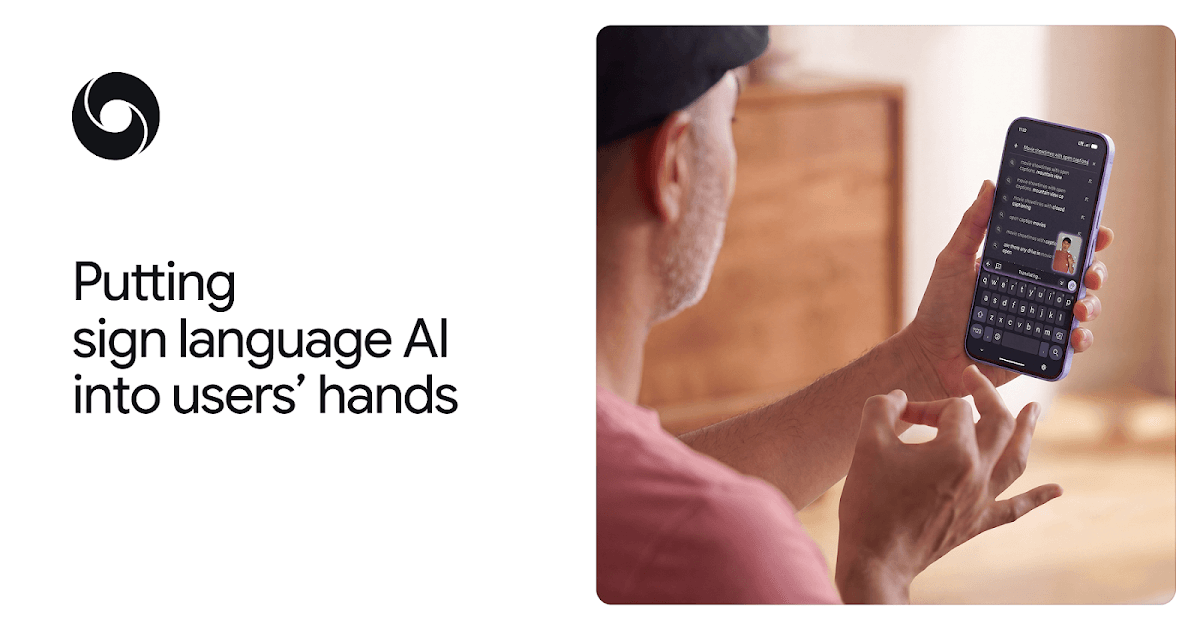
DeepMind announced SL2T — a sign-language-to-text model — and it's already
powering real features for Deaf and hard of hearing users, not sitting in a
research blog waiting for a product team to find it. That last part is the
actual news.
What it does
SL2T takes continuous signing from a camera feed and transcribes it to text in
real time. The hard part of sign language AI has never been recognizing a
static gesture — it's the grammar. Sign languages pack meaning into motion:
handshape, movement, location, and facial expression all at once, and the
order isn't anything like spoken-language syntax. Early systems treated signs
like isolated vocabulary words and produced robotic, unusable output. SL2T is
built around continuous signing, which is the only framing that survives
contact with a real conversation.
Why this one matters
Three reasons I'd put this above most model releases this month:
It's assistive tech that respects the user. The framing is "features for
Deaf and hard of hearing users," not "we can now transcribe sign language for
hearing people who find it inconvenient." That distinction shows up in the
design — the model is meeting users where they already are, in video calls and
daily apps, instead of demanding they come to a new tool.
It's a rare genuinely-hard multimodal problem. Most "multimodal" releases
this year are the same vision encoder with a new label. Sign language forces
the model to reason about motion and context over time, which is a different
class of difficulty than captioning an image.
It shipped. The gap between a research demo and a shipped feature is where
most AI value dies. DeepMind is historically a research org; seeing SL2T
actually power features is the more interesting signal — it suggests the
pipeline from lab to product inside Google is shortening.
What I'd watch next
SL2T is region-aware out of the gate, but the long tail is sign languages, not
the models — ASL and BSL get coverage first, smaller sign languages will wait.
If DeepMind opens this up the way it's done with other accessibility models,
community data will do the heavy lifting. If it stays behind an API, we'll see
a dozen startups re-skin it within a quarter. Either way, the bar for sign
language AI just moved.
The original announcement is worth reading in full:
Putting sign language AI into users' hands
— this is my take on what it means, not the source.