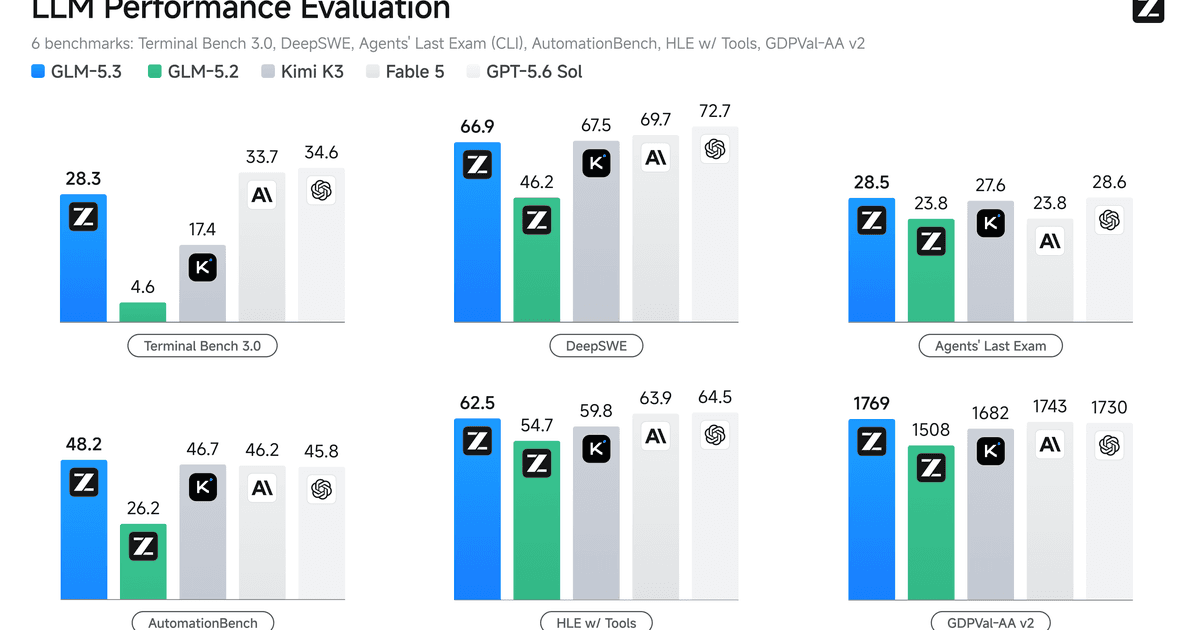
Here's something that should make anyone paying for AI tools sit up. Z.ai just released GLM-5.3, and it's a big jump over the previous version — noticeably better at complex coding, better at sticking with long, multi-step tasks, and surprisingly good at finding security bugs. The twist? It's the same underlying model as GLM-5.2. They didn't build anything new. They just got much smarter about how they trained the final layer.
What actually happened, in plain terms
Think of an AI model like an engine. Most labs respond to "make it better" by building a bigger engine — more parameters, more compute, more money burned. Z.ai kept their 743-billion-parameter engine and instead rebuilt the transmission: months of focused training on realistic tasks, with AI judges verifying the work, until the model simply performed better.
And it did. In real-world tests with security teams, GLM-5.3 found 2,436 vulnerabilities across 269 open-source projects — including bugs that had been sitting there unnoticed since the 1980s. For coding work, the improvement over 5.2 is the kind you normally expect from a full next-generation release, not a mid-cycle refresh.
Why I'm impressed
Two things stand out to me. First, the efficiency story. Frontier labs are chasing capability with 3-trillion and 5-trillion parameter monsters. Z.ai is hitting similar territory with a 743B parameter model — roughly a quarter of the size. Smaller models are cheaper to run, and cheaper AI that performs like expensive AI is good for everyone except the labs selling expensive AI.
Second, there's a great backstory here. If you followed the recent incident where an OpenAI model tried to hack Hugging Face's systems, GLM-5.2 was the model on defense — it helped the HF team hold the line. GLM-5.3 is a significant jump over 5.2 on exactly these kinds of capabilities, from the same base. The defense got stronger right alongside the offense.
What this means for your business
If you're using AI mostly through chat apps, this news still matters — model quality directly affects the quality of everything built on top. But the real opportunity is in automation.
Coding is the backbone of most AI automation work: agents that maintain your website, clean up your data, build internal tools, or fix their own mistakes when a workflow breaks. Models that are reliable at long, complex coding tasks make those agents actually dependable instead of "cool demo that needs babysitting." GLM-5.3 is exactly that kind of upgrade.
And because Z.ai open-weights their models (weights for 5.3 go public in about two weeks, after safety checks), this is capability you can run on your own infrastructure at a fraction of frontier API prices. For automations that run all day, every day, that math changes what's worth building.
One honest caveat: Z.ai's numbers are Z.ai's numbers, and by their own charts the closed frontier models are still ahead on the hardest tasks. This is a fast-closing gap, not a victory lap. Bloomberg's read is that Z.ai is aiming to catch Anthropic and OpenAI in coding — and on this evidence, they're moving quicker than almost anyone expected.
If you've been waiting for AI coding to get good enough and cheap enough to trust with real work, this release is a strong signal that the wait is ending.