There's a pattern I keep seeing in edge AI announcements: a small model ships, the benchmarks look fine for its size class, and then you actually run it and wonder why you bothered. LiquidAI's new LFM2.5-VL-3B is not that.
What happened
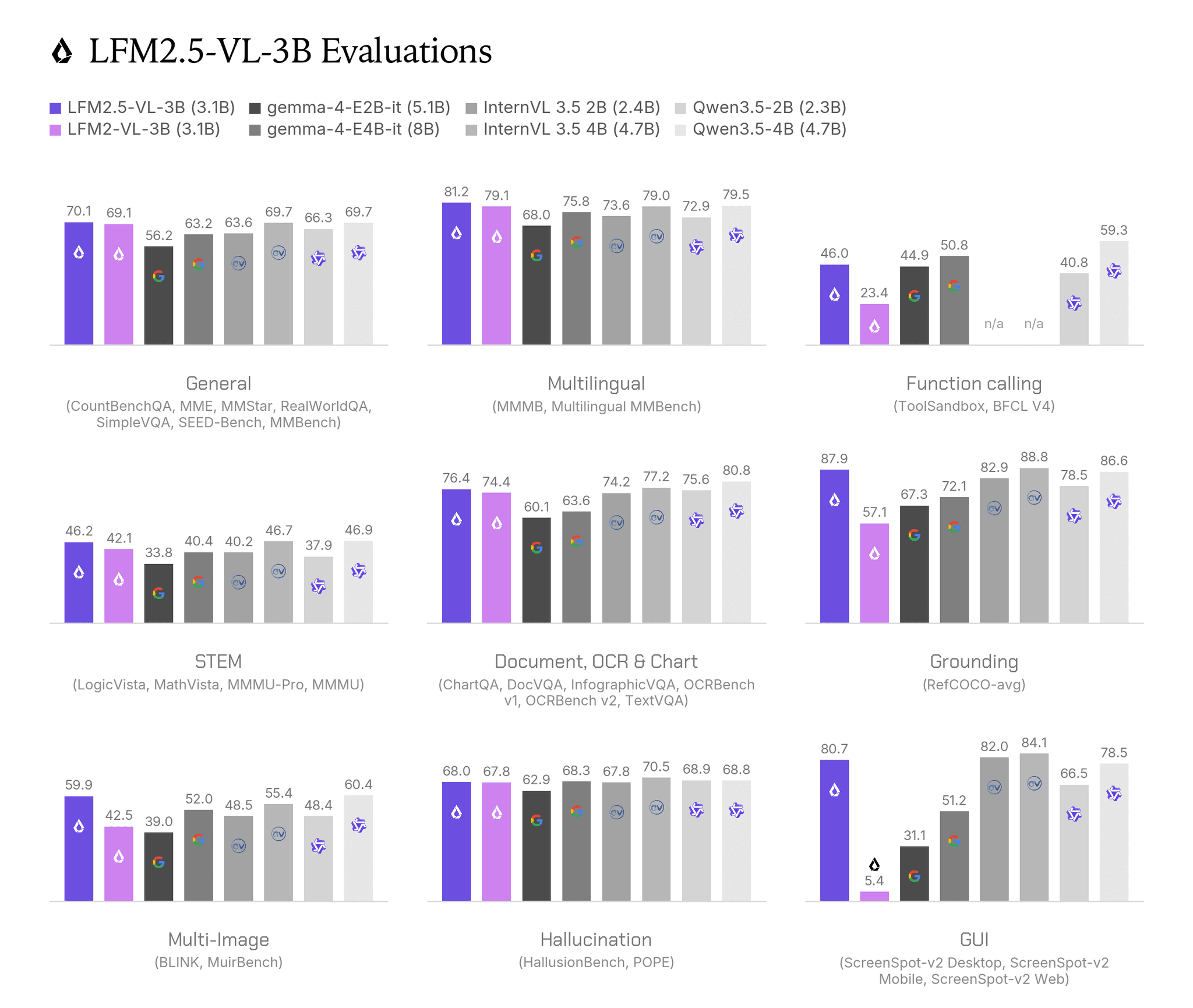
LiquidAI released LFM2.5-VL-3B, a 3.1-billion-parameter vision-language model — small enough to fit in about 3 GB of memory — and it's beating models much larger than itself. On the average across LiquidAI's benchmark suite, it scores 69.4, ahead of Google's Gemma-4 E4B at 8B parameters (59.7) and the 5.1B Gemma-4 E2B (52.0). It also edges out Qwen3.5-4B and matches InternVL 3.5 4B.
The genuinely striking numbers are in screen understanding. On ScreenSpot-v2 Web, the previous LFM2-VL-3B scored 2.5. This one scores 82.2. That's not an increment; that's a new capability arriving in the same footprint. The model also handles object grounding (pointing at things you ask about in natural language), multi-image reasoning, and function calling — noticeably better than its predecessor on tool use, where it's now on par with Gemma-4 E2B and Qwen3.5-2B.
Speed is the other half of the story. LiquidAI reports 228 tokens per second on an M5 Max, 116 on a Ryzen AI Max+ 395, and — this is the one that stopped me — 20 tokens per second on a Galaxy S26 Ultra. Fully on-device, no cloud, no API bill. It ships day-one with llama.cpp, MLX, vLLM, SGLang, and ONNX support, and there's a WebGPU demo that runs it in a browser tab.
What it means for how you work
If you've been priced out of adding AI to small internal tools — a document reader, a screen assistant, a support bot for a low-traffic product — the economics just changed. A model like this turns "AI feature" from a monthly API line item into a one-time engineering task. It sees images, reads documents and charts, understands UI screenshots, and can call your own functions. That combination covers a surprising amount of real business work: extracting data from invoices, describing what's on a screen, answering questions about a photo.
The privacy angle matters too. Data that can't leave the building — client documents, internal screenshots, anything under a strict data policy — can now be processed by a competent model that never makes a network call.
My take
This looks like a pretty good alternative for simple chatbots that run fully locally on a regular laptop. Beating Gemma E2B and E4B at only 3.1B parameters means it's more than enough for basic tasks — and since it runs locally, it costs nothing. Vision capability on top of that is a genuine bonus, because most models in this weight class are text-only.
That said, I want to be clear about the ceiling. I would still not use small local models for anything even marginally complex. Multi-step reasoning, nuanced analysis, tricky code — that stays with the frontier models. The right mental model here is a division of labor: big cloud models for the hard thinking, small local models for the high-volume, well-defined tasks where cost and privacy dominate. LFM2.5-VL-3B just made the second bucket a lot more capable, and that's exactly where it should stay.