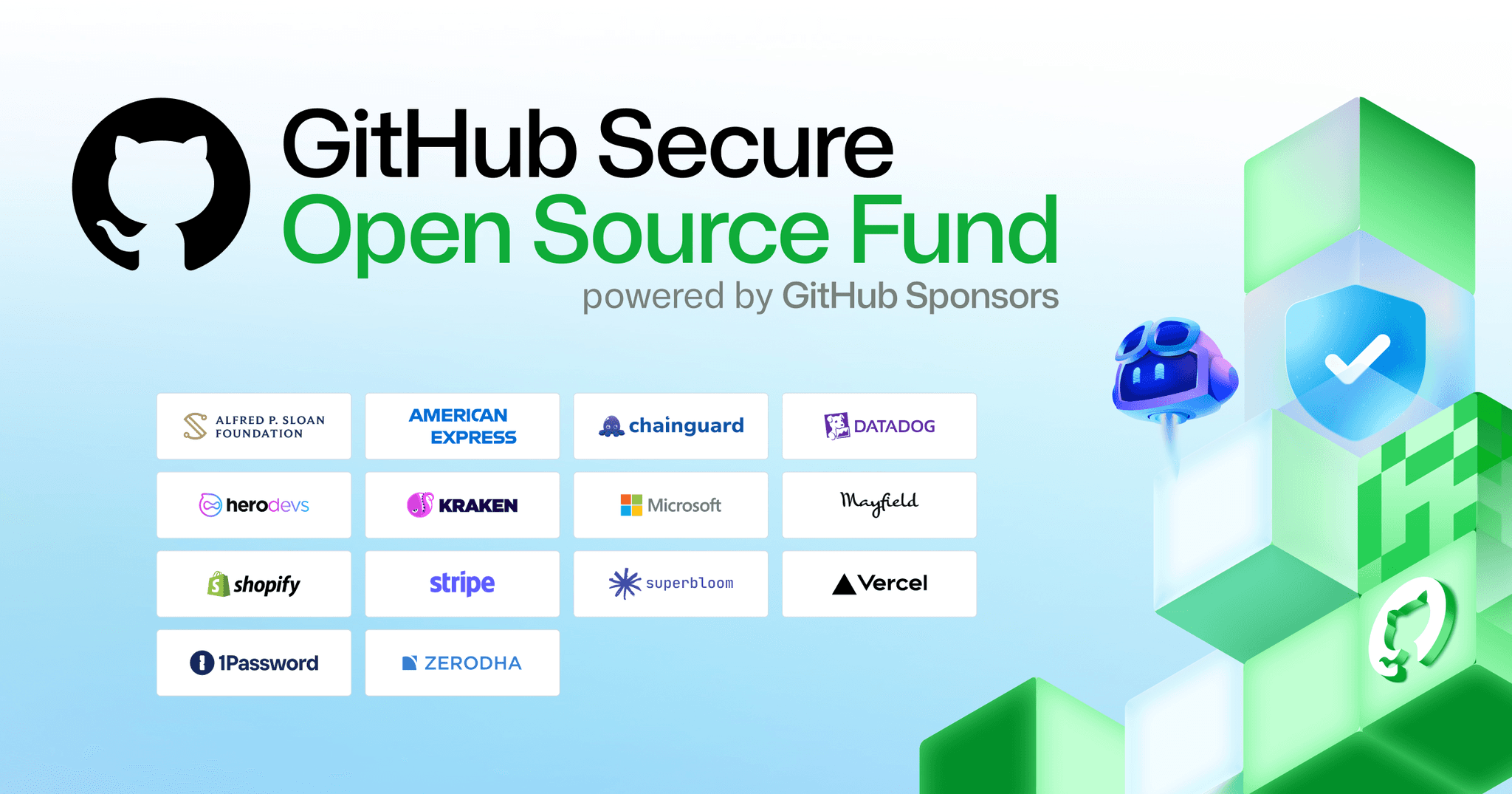
The software you build on top of — the frameworks, the runtimes, the libraries you install without thinking — is maintained by a small number of people who almost never have security as their day job. GitHub just published results from the fourth session of its Secure Open Source Fund, which put more than $500,000 across 50 open source projects, and the findings say a lot about where security is heading now that AI is in the loop on both sides.
What happened
Each of the 50 projects received $10,000 via GitHub Sponsors, a three-week sprint designed by GitHub Security Lab covering threat modeling, secure coding, and AI-era vulnerability management, plus a year of office hours and a peer community. The cohort reads like the backbone of modern software: LangChain, ONNX, core-js, htmx, Pyodide, Pillow, golangci-lint, browserslist, CycloneDX. If you shipped anything this year, some of your dependencies were probably in that list.
The lesson GitHub says emerged consistently: AI helps maintainers investigate, prioritize, and respond faster — but maintainers still provide the context, judgement, and accountability that decide what ships. Projects used Copilot-assisted workflows for vulnerability triage, threat modeling, code review, and remediation, and came out with incident response plans, hardened CI pipelines, and actually-audited release processes. OpenClaw, GitHub's fastest-growing project, used its session to build an incident response plan from scratch and audit its GitHub Actions workflows.
What it means for how you work
Two practical takeaways if you run anything in production.
First, your dependency tree is both more attacked and more defended than it was a year ago. AI has handed attackers a faster way to find and weaponize vulnerabilities in open code — that's not hypothetical anymore. But the same acceleration is flowing to maintainers, and programs like this are wiring it in deliberately. The supply chain isn't getting safer by accident; it's getting safer because funded humans with AI tooling are doing unglamorous work on packages you depend on.
Second, the division of labour matters for your own team. The pattern GitHub describes — AI triages and drafts, humans hold context and accountability — is exactly the shape your internal security process should take. If a three-week sprint plus expert access materially improved projects that run billions of downloads, a smaller version of that structure will improve your repo too: threat model first, AI-assisted triage second, a named human who owns the decision to ship.
My angle
Given how fast the models are evolving, the foundational software we all build on has to stay absolutely secure — we trust those packages and lean on them for mission-critical work every day. Here's the uncomfortable truth in this space: we can't stop malicious actors from using open-weight frontier models to hunt for vulnerabilities. That door is open and it doesn't close.
What can be done is making sure the white hats run faster than the black hats. That's exactly what this program is: subsidized security work on critical infrastructure, at AI speed, with funding tied to verified outcomes rather than vibes. I'd go further than GitHub's framing — I think computing as a whole is going to get more secure, much faster, because of AI, not in spite of it. Defenders have always had the structural advantage of coordination; now they have the speed too.
For Zyntopia's clients, the play is direct: budget for AI-assisted security review of your own stack the way these maintainers did. The tools are cheap, the workflows are proven, and the alternative is hoping the people who find your vulnerabilities first are the friendly kind. Applications for Session 5 of the fund are open until August 24 — if you maintain or depend on OSS worth protecting, that's a deadline worth knowing about.