Most businesses adopting artificial intelligence make the exact same unexamined assumption: they pick one flagship AI provider, sign up for enterprise API accounts, and route 100% of their team's workflows through that single model.
At first, it seems sensible. It feels clean, simple, and modern.
Six months later, the business consequences catch up:
- Skyrocketing monthly invoices: You are paying premium flagship rates for every routine task, simple query, and code review.
- Single-vendor vulnerability: When that provider suffers an outage, changes its model behavior overnight, or rate-limits your team during a critical launch, your operations grind to a halt.
- Unchecked hallucinations in high-stakes decisions: When a lone AI model makes a subtle error in a technical architecture plan or a data analysis report, there is no second opinion in the room to challenge it.
You would never run a company by letting a single individual make major financial or engineering decisions without peer review. Yet that is precisely how most organizations deploy AI.
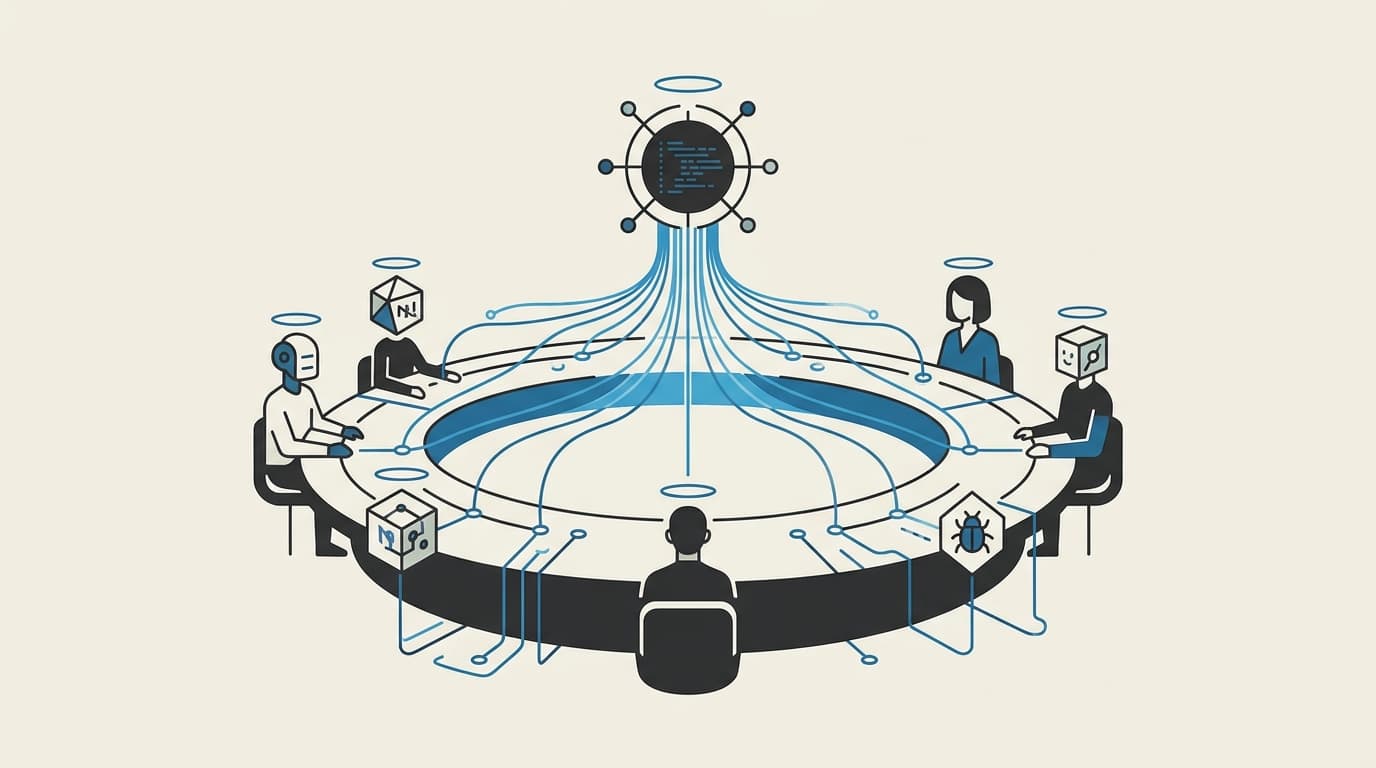
Earlier this year, landmark research from OpenRouter proved there is a much smarter way to operate. By fanning out tasks to a panel of diverse, inexpensive models and synthesizing their answers through a structured judge, a budget panel of cheap models consistently beat solo frontier models on deep research and complex reasoning tasks—landing within ~1% of top-tier models like Claude 3.5 Sonnet and Fable 5, at half the operational cost.
This approach is called multi-model fusion.
With open tools like OpenFusion, you no longer need to depend on proprietary cloud platforms to harness it. Here is why forward-thinking leadership teams are moving to multi-model architectures, how it cuts operational costs, and how it transforms AI from a costly novelty into a sustainable competitive advantage.
1. Slashing costs without compromising quality
The single biggest drain on AI budgets is using top-tier frontier models for work that does not require them. Flagship models charge a massive premium per million tokens. When your team uses them for every step of research, drafting, and analysis, the unit economics deteriorate quickly.
The OpenRouter findings revealed a counterintuitive mathematical reality: model diversity plus structured synthesis beats raw model size.
When you combine three lightweight models (costing pennies per million tokens) and use a capable model solely to synthesize their answers, you achieve three immediate financial wins:
- Lower cost per solved problem: Instead of running ten iterations on an expensive model to get an answer right, a single multi-model panel gets it right on the first pass at a fraction of the total token cost.
- Optimized token allocation: You reserve high-tier compute strictly for the final synthesis step, allowing cheap open-weight or budget models to handle the heavy reading and parallel generation.
- Predictable operational forecasting: Your software and consulting expenses stop swinging wildly based on one vendor's pricing adjustments.
You don't need a million-dollar model budget to get frontier results. A disciplined panel of focused models, properly synthesized, produces better outcomes at half the price.
2. Eliminating hallucinations in critical operations
When a business uses AI for internal operations, code development, or strategic research, the true cost of an error is never the API token fee. The true cost is the forty hours of engineering time spent fixing a flawed database architecture, or the lost client trust when an inaccurate report goes out.
Single models fail silently because they have no internal mechanism to cross-examine their own assumptions.
A multi-model pipeline introduces built-in consensus verification:
- Consensus filtering: If three independent models trained on completely different datasets arrive at the same conclusion, the probability of a hallucination drops near zero.
- Contradiction resolution: When models disagree, the pipeline does not flip a coin. The two-step judge flags the conflict explicitly, analyzes the trade-offs, and presents a reasoned resolution.
- Catching blind spots: If one model identifies a critical data privacy requirement that two others overlooked, the synthesis step captures that insight instead of discarding it.
This turns AI from an unpredictable creative tool into a reliable operational instrument.
3. Total vendor independence and data sovereignty
If your entire business relies on one AI provider's proprietary APIs, that provider owns your roadmap. If they deprecate a model, change their content moderation filters, or adjust their commercial terms, your business is forced to comply.
Building around local, open multi-model architectures like OpenFusion restores full control to your company:
- Zero vendor lock-in: Swap models in and out in sixty seconds. If a new, more efficient model launches today, your team can add it to the council immediately without rewriting software or changing internal tools.
- Hybrid private and cloud execution: Mix cloud APIs with completely private, on-premise models running on your own hardware (e.g., via Apple Silicon or local GPU servers). Confidential business records stay on your machines, while public reasoning tasks can tap the cloud.
- Encrypted, self-hosted key management: API keys and operational databases reside on your team's hardware—never pooled in a shared third-party database.
Strategic comparison: single-vendor AI vs. multi-model fusion
| Business Dimension | The Single-Vendor Trap | The Multi-Model Advantage |
|---|---|---|
| Cost profile | Premium flagship rates for all tasks | Budget panel + targeted synthesis (50–70% savings) |
| Operational reliability | Single point of failure on provider outages | Automatic fallbacks and panel resilience |
| Accuracy & trust | Unverified single-model output | Cross-model consensus and contradiction resolution |
| Strategic agility | Locked into one company's ecosystem | Instant model swapping and vendor independence |
| Data governance | All data leaves to one cloud platform | Flexible hybrid routing (on-premise + cloud) |
How to evolve your team's AI maturity
Transitioning your organization from ad-hoc AI usage to a disciplined multi-model capability does not require a six-month IT overhaul. It happens in three practical phases:
- Equip your current tools: Connect local MCP tools like OpenFusion to the coding assistants and research agents your team already uses (such as Claude Code, Cursor, or Codex).
- Establish task-specific councils: Configure dedicated model panels for different departments—one focused on code review and security, another on financial document synthesis, and another on product strategy.
- Audit and optimize spend: Review your local SQLite activity ledger to identify which models deliver the highest quality-to-cost ratio for your specific workflows, continuously tuning your model lineup.
The bottom line for leadership
The winners of the AI wave will not be the companies that spend the most money on raw API credits.
The winners will be the organizations that design resilient, cost-efficient, and multi-perspective architectures that deliver dependable business results day in and day out.
Multi-model fusion turns artificial intelligence from an unpredictable expense into a high-margin, verifiable asset.
If you want to evaluate your company's AI workflows, eliminate vendor lock-in, and deploy high-leverage multi-model pipelines across your team, book a strategy consultation—let's build a practical AI architecture that drives real business growth.